)_edited.png)
Theobroma cacao ~ A journey through a name

Updated: 1 day ago
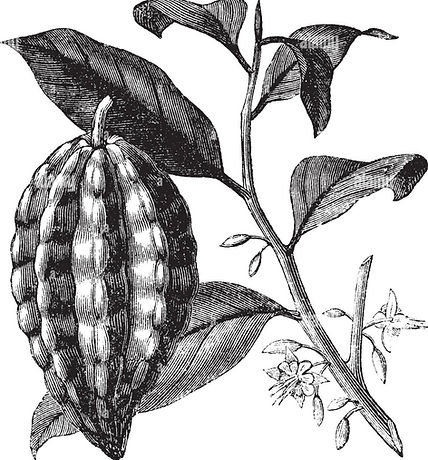
From Linnaeus
In 1707, in southern Sweden, a soul was born who, from childhood, was nurtured by a deep love for plants and flowers. Becoming a physician and botanist, Carl von Linnaeus devoted his life to observing, classifying, and naming living species, guided by the conviction that every being carries within it a sacred language.
We are in 1757. In his study — which we like to imagine filled with herbariums and seeds from all over the world — he is about to name a tropical plant with a mysterious aura: cacao, derived from the Nahuatl word cacáhua(tl), the language of the Nahua peoples of pre-Columbian Mexico. Taking into account the stories surrounding this plant, or perhaps simply sensing its essence, he gives it a name blending Greek roots and Nahuatl origin, transcribed in the scholarly language of his time: Theobroma cacao — from the Greek theos (god) and broma (food), literally “food of the gods” — followed by the letter L., for Linnaeus, author of the botanical classification.
When pronouncing these words for the first time, who knows whether the greatness of cacao resonated within him, confirming the rightness of the name he had just bestowed with the authority of his science.
Of the ancient gods
Long before cacao received this scholarly name, it already lived at the heart of myths and offerings. Among the Olmecs, the first to cultivate it, cacao already seemed linked to fertility and regeneration.
The Maya regarded it as a gift from the gods: the Popol Vuh, sacred book of the K’iche’ Maya (written after the Spanish conquest, recounting the creation of the world and the first humans), tells that human beings were shaped from maize, but that cacao was among the precious plants offered by Mother Earth to nourish the spirit of humans and maintain their connection to the divine.
According to certain traditions, the god Kukulkan, the feathered serpent, himself brought cacao to humankind.
Ancient depictions also evoke goddesses of fertility and abundance associated with this plant. The name IxCacao, later popularized in ethnographic literature, symbolizes this feminine energy of prosperity and Earth, although it does not appear explicitly in known Maya codices.
Among the Aztecs, cacao bore the seal of Ek Chuah, god of trade and cacao.
Ancient accounts tell us that cacao accompanied ceremonies and rituals, particularly those connected to birth, sowing, unions, mourning, and healing. It was offered to the gods, but also revered as a celestial gift from them.
Of the new gods
In the 16th century, the Spanish encountered cacao — first with suspicion, then with fascination — in Mexico, among the Aztecs, where it was reserved for the emperor, priests, and the nobility. Not without violence, they brought it back to Europe as beans and stories, introducing it to the Spanish court.
Very quickly, cacao lost its sacred dimension. Mixed with spices and sugar — other goods brought from afar — and later with milk to suit European tastes, it became a courtly beverage, one of pleasure and entertainment.
It was soon integrated into the system of triangular trade, alongside other commodities and riches, feeding the slave trade and the accumulation of European wealth at the expense of the Global South. Thousands of enslaved Africans worked on cacao plantations, transported to other colonies to be exploited further, while European courts celebrated the delights arriving from the “New World.”
Those who believed themselves gods now consumed the “food of the gods.”
The scientific name given by Linnaeus in 1757 can thus be read through a bitter lens: that of the white gods — Europeans who dominated, destroyed, and transformed sacred cacao into a prestigious beverage served in royal courts, before spreading among the masses.
It is upon this dark history that the modern cacao industry was built — and continues to stand — without the atrocities having necessarily ceased.
Remembering the authentic meaning of this name is an invitation to recognize the sacred nature of this plant and to look at it differently.
Though cacao was uprooted from its land of origin, transformed, and commodified, it never lost its essence. Its power to open the heart, clarify the mind, and create communion remains intact, provided it is drunk with respect and presence.
Desecrated, it is time to restore its true value — as well as the value of its ancestral lands and the peoples from whom it was taken.
Today, it returns as a messenger. Not to serve the gods of men, but to remind human beings of the divine they carry within.
***
With you.
Sakara


